Saturday, 24 November 2012

Charleston

We sailed into Charleston past Fort Sumter where the first shots of the Civil War were fired.  The next morning we took a tour with a veteran tour guide to get an overview of the city and a rice plantation.  The rice plantations were in their hay-day in the early 1800s to mid-1800s, but after the Civil War when there was so much destruction and slavery was abolished, they were no longer viable.  Many of the land holdings were sold off to the potash industry.  The rice fields of the Magnolia Plantation, which we visited, had reverted back to Cypress swamp.  It is now home to  alligators and migrating waterfowl.  The main house and gardens have been remarkably well preserved, providing a source of tourism today.
We were impressed with the historic city of Charleston.  Their strict rules dealing with the preservation of their historic sites made walking through the streets of Charleston an absolute visual delight.  It was like walking back in time.  The homes had been built by the plantation owners so they had a "town" home in addition to their plantation mansion.  We learned how there are single-room houses (1 room wide) and double room houses (2 rooms wide per floor).  The advantage of the single-room home meant less frontage on the street so there was less tax to pay.  (Some things never change!)  All of the porches faced the ocean to catch the prevailing breeze. The homes and gardens were beautifully restored.  A visit to historic Charleston city was well worth the visit!
Sunbathing ...our first alligator sighting!
Red shouldered hawk looking over the Cypress swamp

Cypress swamp.  Nodules let air into the submerged roots.

Floating duckweed is food for the migrating waterfowl

Ibis birds?

Magnolia Plantation

St. Paul's Cathedral..gothic architecture

Single-room home

Double-room home

Calhoun mansion garden fountain

Hitching post and carriage step


Tuesday, 6 November 2012


Fortunately, we were spared the devastation of Superstorm Sandy  because it veered  northeast and offshore of us in Oriental, NC, then  turned northwest again to lash the coast of New Jersey and New York.  We only experienced 50 mph winds and lots of rain.  There was minimal storm surge.  Windspell suffered no damage.  While waiting out Sandy, we took full advantage of our lovely surroundings.  Donna was in her glory at the fitness centre daily jogging the miles away on the treadmill as the rain slashed down outside.  Walt enjoyed the elliptical followed by the steam shower.  We met lots of other cruisers who shared their experiences along the Intracoastal Waterway (ICW).  We spent the next day undoing all of the preparations we had taken in anticipation of Sandy.  
After being stationary for six days we were glad to continue our southbound voyage which has taken us through Wrightsville Beach, Myrtle Beach, and now we are in Georgetown.  We anchored one evening near Calabash, NC where we had dined 28 years ago when we had done this trip on our previous sailboat.  We had a typical southern dinner of hush puppies with fried shrimp mounded on our plates.  We were delighted to see that nothing had changed in this small fishing town whereas  there has been extensive waterfront development along the ICW with homes and condominiums.  
We are now in the deep south.  We all  know of the vast plantations and the wealth of their owners in this area.  And what did their wealth come from?  Cotton?  No.  Tobacco?  No.  They made their wealth in growing rice and  indigo in this area!  It is unbelievable that they cleared/burned the swamps of cypress trees, drained the swamps, built dykes and planted rice using African slaves.  Of a population of 20,000 people in this area back then, 90 percent were slaves!  Further back from the waterways they grew indigo.  The blue dye was sent to Britain for their naval uniforms.  Many of the plantation owners also had homes in Georgetown.  Strolling the streets of Georgetown you can see the Georgian architecture of their homes, and the streets are lined with Live Oak trees several hundred years old.  
We are now bound for Charleston!


This was the low point during Tropical Storm Sandy...the lowest we have seen our barometer!
Resort River Dunes diningr oom...where we dined during Superstorm Sandy
River Dunes lounge where I beat Walter at Scrabble!
River Dunes pool and fitness centre
Shrimp fleet at Calabash, NC


Cypress swamp along Waccamaw River near Georgetown, SC


diorama showing how the slaves cleared the swamps to  prepare for rice fields
 diorama showing rice fields around Georgetown, South Carolina in early 1800s

Georgetown streets lined with Live Oak trees 

Saturday, 27 October 2012


It's blowing 20 to 38 knots at the moment and we are expecting the brunt of hurricane Sandy by 9 a.m. tomorrow morning. We have Abba on high volume to disguise the howling of the wind and all is good as we have spent the last day preparing Windspell for this "special event". It has been 10 days since we left  Yorktown where we took great advantage of all the historic sites and also did a successful repair of our anchor windlass and had a voluntary US Coast guard inspection which we passed with flying colours. In ten days we have have incredible varieties of experiences and made some  new friends. The photos will explain things well. We hope you don't get too badly effected by Sandy but feel free to join us if you need a safe place to stay....

We will keep you posted.

Donna and Walter

SV Windspell


It's a boat...another repair...a new windlass motor that hauls the anchor up.  It only took Walter 2 days of searching on the internet the entire USA to find one. Thank goodness for the internet;  we didn't have it 28 years ago, but then again, we didn't have an electric windlass.
Norfolk harbour-the largest naval base and busiest seaport in the world.  One of several US aircraft carriers.  To get an appreciation of the size of this ship, check the size of the guy standing on the deck  (LHS) .


Norfolk is mile 0 of the 1100 mile Intracoastal Waterway leading to Miami, Florida.   The first of numerous lift bridges we must pass under.

Entering the lock leading into the Dismal Swamp Canal.  We'll be lifted ten feet.

Dismal Swamp Canal

Sailing across Albermarle Sound to the Alligator River.  Mile 80.

Early morning start...entering the Albermarle-Pungo River canal

Morning mist on the canal

Side trip to Ocracoke Island on Pamlico Sound-the home of  pirate Blackbeard (alias Edward Teach).   

Bike rental to see the ponies of Ocracoke Island.-

DNA samples from the ponies indicate they are descendants of Spanish Mustang ponies- likely  from shipwrecks back in the 1600s.

Voted America's #1 beach for good reason...

We had some awesome body surfing waves 

Overturned horseshoe crab

Pelican in search of his supper

Shorebirds frolicking in the surf

Ocrocoke lighthouse, second oldest original and still functioning in   USA


Gazing inside up the spiral staircase of the lighthouse

We wonder how Hurricane Sandy will measure up...

Windspell stripped and spider strung on a floating dock in a hurricane hole at River Dunes up back creek off the Neuse River in Pamlico Sound    North Carolina

Wednesday, 17 October 2012

Since our departure from Rock Hall just over one week ago, we have sailed 150 miles down the Chesapeake Bay.  We sail somewhere between 40-50 miles each day, stopping at quiet creeks along rivers emptying into the Bay, or visiting towns.  We  try to depart each anchorage just as the sun is rising to make use of shrinking daylight hours.   As we have neared the mouth of the Bay, we have seen dolphins and pelicans!  We have visited historic St. Mary's City -a reconstruction of Maryland's first capital city before it was moved to Annapolis.  The last few days have been spent at the marina, York River Yacht Haven. so we could catch a shuttle bus that visits the three historic towns of Jamestown, Yorktown and Williamsburg.  Walter & I have enjoyed the tours conducted by the National Park staff who have made American history  come alive for us.  It has also been an opportunity  to hunt down a new motor for our anchor windlass that suddenly quit working.  If all goes as planned, we shall soon be leaving the Chesapeake Bay and  entering the Intracoastal Walterway-over 1100 miles of canals, rivers and bays extending from Norfolk, Virginia to Miami, Florida.

A hogshead of tobacco at historic St. Mary's City-the first capital of Maryland

Replica of John Smith's vessel that mapped the Chesapeake Bay in 1608.  

Williamsburg-Virginia's 18th-century capital  city

Captive captain

Milnary in Williamsburg

Silversmith making spoons and wine cups

Home of  George Whythe who taught law to Thomas Jefferson.   Jefferson wrote the Declaration of Independence

Cannon overlooking the Yorktown Battlefield where George Washington with the help of the French defeated  the British General Cornwallis in 1781.  
Model of Jamestown in 1607-the first permanent English-speaking settlement in North America.  

Ongoing archeology at Jamestown


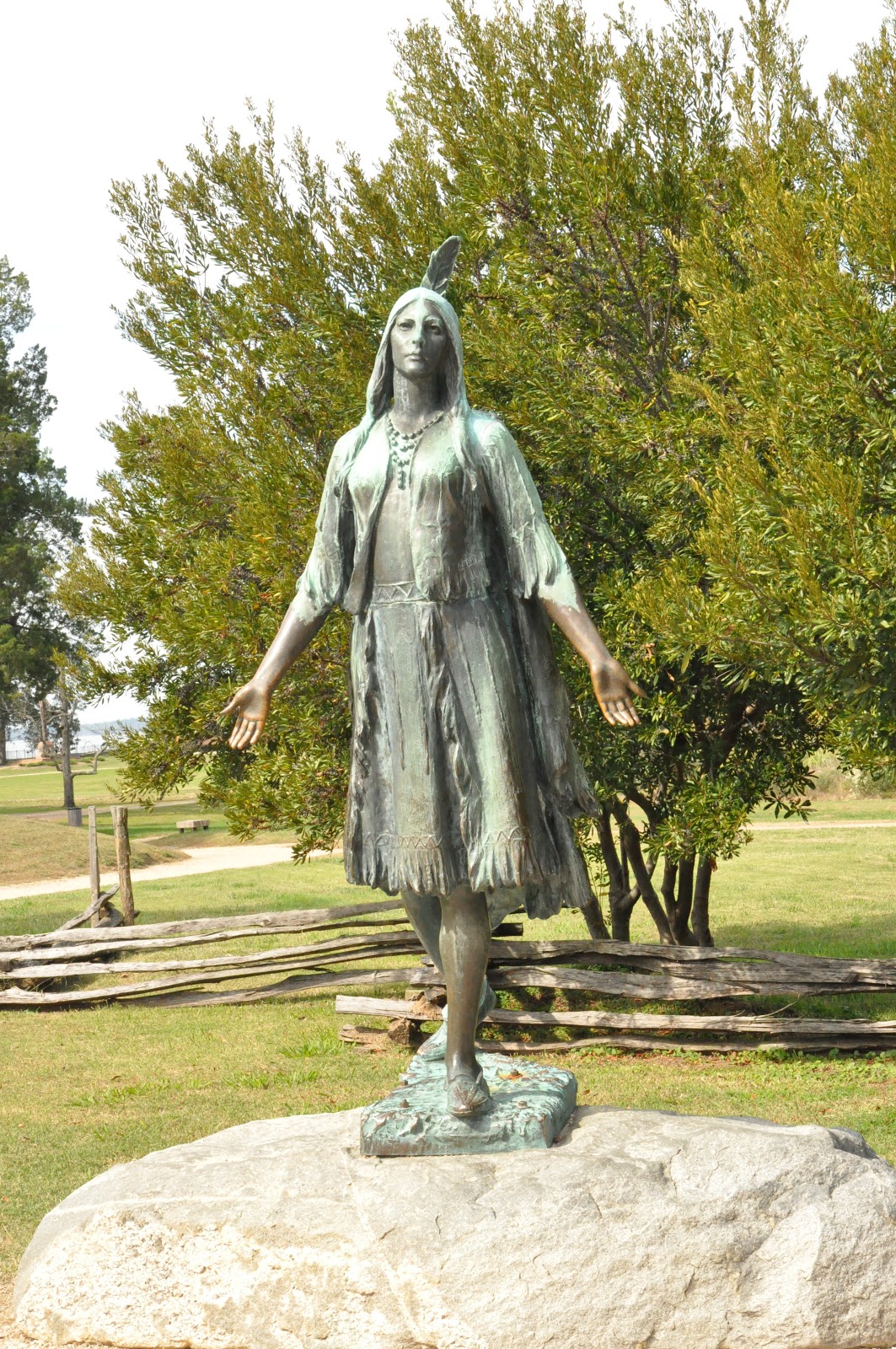
Statue of Pocohontas-who married  Jamestown settler, John  Rolfe.  Rolfe cultivated the first tobacco grown in Virginia.  He later takes Pocohontas and their son back to London where she becomes ill and dies.